1. Background to the Report
With the rapid spread of generative AI, it has become technically possible for anyone to easily use the likeness or voice of another person without their permission and to generate visual images and/or audio recordings in which it seems as if the other person is actually appearing and/or talking. Whether, and if so how, human likenesses and voices can be legally protected in the world of generative AI has become a hotly debated topic.
The debate was further heated by scholarly commentary, including an article by Judge Motoyuki Nakashima, who is widely known to have served as the judicial research official (chōsakan) for the 2012 Supreme Court decision in the case regarding the Mitsuyo Nemoto, et al v. Kobunsha Co., Ltd. (“Pink Lady Decision※1”)※2, the first Supreme Court judgment to rule on the circumstances under which an infringement of publicity rights can be found※3 (the legal commentary of Judge Nakashima in this landmark decision is referred to below as the “Pink Lady Decision Commentary”)※4.
Regarding the use of human likenesses in generative AI, the “Interim Report of the Study Group on Intellectual Property Rights in the AI Era,”※5 published in May 2024 by the Study Group on Intellectual Property Rights in the AI Era, took the position that the criteria for determining infringement of the right to one’s likeness (shōzōken), and the criteria for determining infringement of publicity rights in connection with the use of likenesses of celebrities and others that possess customer-attracting power, should be handled in the same manner as in cases which did not involve generative AI, and that generative AI presented no unique or specific problems to determining the infringement of publicity rights. However, although publicity rights have been recognized under Japanese case law, beginning with the Pink Lady Decision, they remain undeveloped. Specifically, the scope of conduct amounting to infringement of publicity rights was unclear, particularly with respect to the unauthorized use of likenesses and voices by generative AI, for which no judicial precedents exist.
Against this background, in April 2026, the Ministry of Justice established the “Civil Liability for Unauthorized Use of Human Likenesses and Voices Review Committee” (the “Review Committee”)※6. The Review Committee was tasked with analyzing and producing a report on the relevant legal issues, existing case law and the application of tort principles to the infringement of publicity rights and/or the right not to have one’s “likeness, etc.” (the actual term used in the Pink Lady Decision) used without due cause. Specifically, the Review Committee was required to report on how to determine when an infringement of publicity rights and/or the right not to have one’s likeness, etc. used without due cause has occurred, that is, what conditions must be satisfied to prove an infringement of these rights has occurred, and the potential scope of damages, with the goal of enhancing predictability as to the civil liability arising from such infringements.
On 7 August 2026, the Review Committee published its final report, “Civil Liability for Unauthorized Use of Human Likenesses and Voices Review Committee – Final Report: Interpretive Guidelines on Infringement by Generative AI of Publicity Rights, etc.” (the “Report”)※7. The Report contains detailed analysis (including the examination of hypothetical cases) on if and when an infringement of publicity rights and/or the right not to have one’s likeness, etc. used without due cause is proven in connection with the use of generative AI and sets out interpretive guidelines on these matters. Thus, although the Report has no legally binding force, it is nevertheless an important reference point in practice.
This Part 1 and following Part 2 of this newsletter series discuss the central aspects of the Report: this Part 1 discusses the infringement of publicity rights, and the next issue will discuss infringement of the right not to have one’s likeness, etc. used without due cause, in each case focusing on what conditions need to be proven to establish that an infringement has occurred※8.
2. Seven Hypothetical Cases that the Report Examines
The Report analyzes the legal protection of likenesses, voices and the like, centering on publicity rights and the right not to have one’s likeness, etc. used without due cause. It then examines seven hypothetical cases (summarized below) concerning the unauthorized use of likenesses and voices by means of generative AI applications and examines how claims for damages, injunctive relief and other remedies against the defendant, identified as “Y” in each hypothetical case, could potentially be pursued.
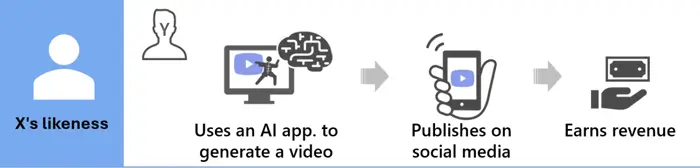
Hypothetical Case 1: Unauthorized use of actor’s likeness in video work
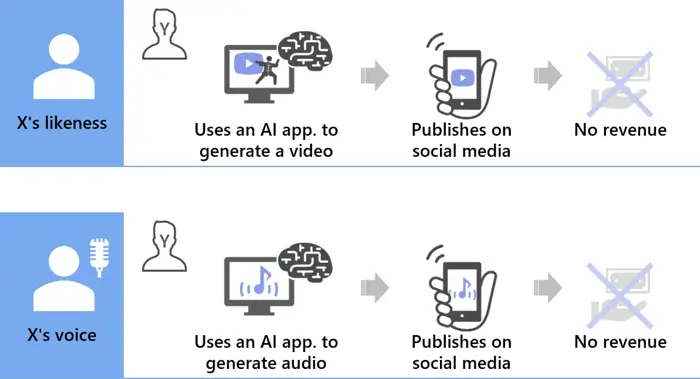
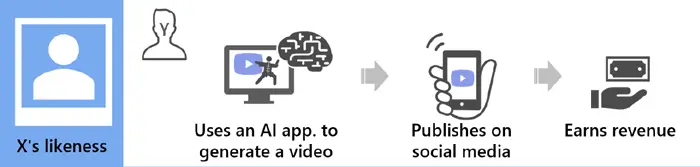
Y, without the authorization of X, an actor, uses a generative AI application to generate a video in which a person whose face closely resembles the face of X performs an action scene, and publishes it on social media, thereby earning revenue.
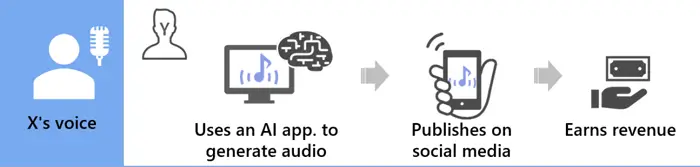
Hypothetical Case 2: Unauthorized use of voice of singer or voice actor (of an animation character played by the voice actor) in distributed audio work
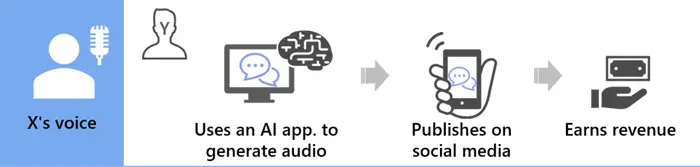
Y, without the authorization of X, uses a generative AI application to generate audio in which a musical composition of A is sung in a singing voice closely resembling the singing voice of X, and publishes it on social media, thereby earning revenue. In Hypothetical Case 2-1, X is a singer. In Hypothetical Case 2-2, X is a voice actor, and the audio in question uses a voice closely resembling that of an animation character, voiced by X.
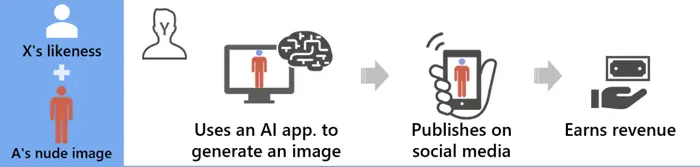
Hypothetical Case 3: Unauthorized use of actor’s likeness or a voice actor’s voice in sexual image or audio work
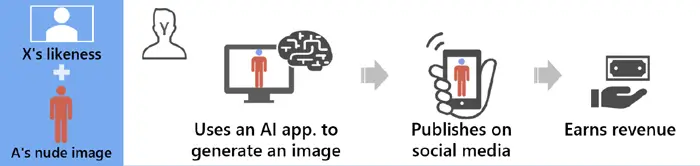
Hypothetical Case 3-1: Y, without the authorization of X, an actor, inputs the likeness of X and a nude image of A into a generative AI application, instructs it to composite the face of X with the nude body of A, generates an image in which X appears to be naked, and publishes it on social media, thereby earning revenue.
Hypothetical Case 3-2: Y uses a generative AI application to synthesize the voice of X, a voice actor, generates audio in which X appears to be reading out obscene text, and publishes it on social media, thereby earning revenue.
Hypothetical Case 4: Unauthorized use of actor’s likeness or voice actor’s voice without a profit-making purpose
Y, without any profit-making purpose and out of mere curiosity, (i) generates the video in Hypothetical Case 1 and publishes it on social media (Hypothetical Case 4-1), or (ii) generates the audio in Hypothetical Case 2-1 and publishes it on social media (Hypothetical Case 4-2).
Hypothetical Case 5: Exclusive license or assignment of publicity rights to talent agency to which the person belongs
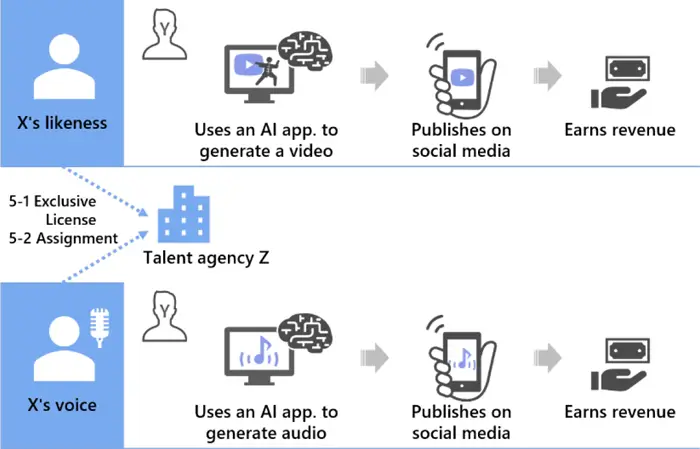
Under Hypothetical Case 1 or 2-1, X enters into an agreement with talent agency Z that (i) grants Z an exclusive license to use the publicity rights held by X (Hypothetical Case 5-1), or (ii) assigns to Z the publicity rights held by X (Hypothetical Case 5-2).
Hypothetical Case 6: Unauthorized use of likeness of deceased actor in video work
Y uses a generative AI application to create a video work in which a person whose face closely resembles that of X, a deceased actor, performs an action scene, and publishes it on social media, thereby earning revenue.
Hypothetical Case 7: Unauthorized use of likeness of deceased actor in sexual image
Y inputs the likeness of X, a deceased actor, and a nude image of A into a generative AI application, instructs it to composite the face of X with the nude body of A, generates an image in which X appears to be naked, and publishes it on social media, thereby earning revenue.
3. Understanding the laws analyzed in the Report
3.1 Relationship between publicity rights and the right not to have one’s likeness, etc. used without due cause
As to the relationship between (i) publicity rights and (ii) the right not to have one’s likeness, etc. used without due cause, the Report notes that both constitute rights derived from personality rights. However, the Report repeats the view stated in the Pink Lady Decision Commentary that (i) and (ii) differ in the legal interests they protect: publicity rights protect the proprietary interests arising from the commercial value of a likeness, etc., whereas the right not to have one’s likeness, etc. used without due cause protects the personality interests arising from the mental (non-pecuniary) value of a likeness, etc. In other words, although the two differ in their content and the subject matter requiring protection, it is possible for both rights to exist and apply in respect of the same single act. Consequently, the Report concludes that an infringement of publicity rights and an infringement of the right not to have one’s likeness, etc. used without due cause may also arise and coexist in respect of a single act※9.
3.2 Protection of the human voice
The Pink Lady Decision only gave limited express examples of the “likeness, etc.” protected by publicity rights and the right not to have one’s likeness, etc. used without due cause: a person’s “name” and their “likeness.” Accordingly, the question arises whether a voice is included within “likeness, etc.” With respect to publicity rights, the Report concludes that a voice falls within the subject matter protected by publicity rights, on the grounds that (i) the Pink Lady Decision Commentary expressly states that a likeness, etc. constitutes information identifying the person concerned and as the voice of a person is such identifying information, a person’s voice is therefore protected by publicity rights, and (ii) even under the predominant view that a likeness, etc. protected by publicity rights must be capable of being described as a “symbol or mark of a person’s individual character,” it would seem uncontroversial for a person’s voice to be included within such description and therefore, a person’s voice falls within the protected subject matter. Similarly, the Report concluded that the mental (non-pecuniary) value of a person’s voice also falls within the subject matter protected by the right not to have one’s likeness, etc. used without due cause※10.
4. How to prove infringement of publicity rights
4.1 Conditions to be satisfied to prove infringement of publicity rights
The Supreme Court judgment in the Pink Lady Decision held that:
“the act of using a likeness, etc. without authorization is, where it can be said that the act is mainly for the purpose of exploiting the customer-attracting power possessed by the likeness, etc., such as where (1) the likeness, etc. itself is used as goods, etc. that are an independent object of appreciation, (2) the likeness, etc. is affixed to goods, etc. for the purpose of differentiating those goods, etc., or (3) the likeness, etc. is used as an advertisement for goods, etc., properly construed to be unlawful under tort law as an infringement of publicity rights.” (emphasis added)
The categories (1) through (3) above are referred to collectively below as the “Three Categories,” and each as “Category 1”, “Category 2” and “Category 3”, respectively.
Based on this key text of the Pink Lady Decision, the Report concludes that an infringement of publicity rights is established to have occurred when it is proved that:
“a person’s likeness, etc. possesses customer-attracting power and the unauthorized use of that likeness, etc. is mainly for the purpose of exploiting the customer-attracting power possessed by the likeness, etc.”
The Report further concludes that the Three Categories are the typical, but not exclusive, instances of infringement※11. Even where a situation does not fall within any of the Three Categories, if it is nevertheless comparable to any of them or otherwise satisfies the above quoted requirements then it may fall under the bolded and underlined wording “such as” in the above quoted text and thus constitute an infringement of publicity rights. In other words, the Report concludes there to be three limbs to the test for proving an infringement of publicity rights, namely:
-
the person’s likeness, etc. possesses customer-attracting power;
-
that likeness, etc. is used; and
-
that act of use is mainly for the purpose of exploiting customer-attracting power.
Each limb of this test is explained further below.
4.1.1 Limb 1: When a likeness, etc. is found to possess “customer-attracting power”
The Report describes customer-attracting power as “the power to promote the sale of goods, etc.” The Review Committee has further confirmed that (i) whether the person is a celebrity or well known is merely one factor in making this determination, and customer-attracting power may also be found where the appeal is to customers in a particular field or in a limited geographic area, and (ii) the fact that a likeness, etc. has been commercially exploited by the user of the likeness may in some cases substantively corroborate its customer-attracting power.
As to point (ii) above, in its examination of the hypothetical cases the Report states that, in light of the specific manner in which a likeness or voice is used, there are situations in which the manner of use itself corroborates customer-attracting power (for example, where a particular audience segment is contemplated and the video or audio appears to have been created and published in the expectation that such audience will focus on the likeness or voice)※12 and situations in which it does not (for example, where a person’s likeness is used but the use is limited and attracts little attention)※13.
4.1.2 Limb 2: When a likeness, etc. is found to be “used”
The Report states that, in order for a likeness, etc. (such as the person’s likeness or voice) to be regarded as having been “used,” customers must be able to identify the likeness, etc. used as being that of the person concerned. Where the matter at issue is not the person’s likeness, etc. itself but a likeness, etc. resembling that person, whether such use exists is to be determined by considering, in the aggregate, the degree of resemblance together with additional information evoking the person concerned (for example, characteristics such as clothing and behavior, or the express or implied identification of a particular person outside the video or audio, and any other contextual factors※14)※15. On the other hand, even where any such additional information evokes the likeness or voice of a particular person, if the likeness or voice itself bears almost no visual or auditory resemblance to the person concerned, there should be determined to be no use of the person’s likeness or voice※16.
As for voices, while the Report notes that voices may in some respects be less distinctive as identifiers than names or likenesses, it also states that whether a voice has been used is to be determined under the same framework as for likenesses.
-
Characteristics of generative AI
The Report further states that, because a likeness output by generative AI does not directly use, in the generation process, the source data contained in the training dataset, such a likeness is not completely identical to the person’s actual likeness or voice (it merely resembles it), and whether there has been use of the person’s likeness, etc. in an AI-generated product must be determined on a case-by-case basis. However, the Report states that where, through adjustment of prompts or otherwise, an image or the like resembling the person’s likeness is the output and such output is used for the purpose of mainly exploiting its customer-attracting power, an infringement of publicity rights could be established even if the information used in the generation process did not include the person’s actual likeness.
-
Impersonation and voice imitation
The Report also addresses impersonation and voice imitation. Although these evoke the likeness or voice, etc. of the person concerned, they are ordinarily performed with the identifying information of the performing impersonator expressly indicated. Based on the view that (i) an impersonation does not use the person’s actual likeness, etc., and (ii) impersonation and voice imitation attract attention through the performer’s own artistry and therefore lack the requirement of being “mainly for the purpose of exploiting customer-attracting power” of the likeness, etc. itself (see the immediately below Limb 3 explanation), the Report concludes that, as a general rule, impersonation and voice imitation do not constitute infringement of publicity rights. It should be noted, however, that where the impersonating or voice-imitating performer is not identified and the likeness, etc. is used in a manner likely to cause customers to mistake it for the person’s own likeness or voice, there is room for infringement of publicity rights to be found.
4.1.3 Limb 3: “Mainly for the purpose of exploiting the customer-attracting power possessed by the likeness, etc.,” the Three Categories, and related matters
Premised on the existence of the use of a likeness, etc. possessing customer-attracting power, the Report states that, for an infringement of publicity rights to be proven, the act of use must be mainly for the purpose of exploiting the customer-attracting power possessed by the likeness, etc. As to the meaning of “mainly,” the Report states that it would be inappropriate to construe the term unduly strictly. On that basis, the Report discusses as follows the Three Categories, cited in the Pink Lady Decision as typical instances in which such a purpose is found, and the “such as” category comparable to them.
4.1.3.1 The Three Categories and their application
Category 1
Use of the likeness, etc. itself as goods, etc. that are an independent object of appreciation
The typical instances of Category 1, i.e., use of “the likeness, etc. itself as goods, etc. that are an independent object of appreciation,” are promotional photographs (bromides), posters, magazine pictorial photographs and the like using a likeness. The Report also notes that:
-
even where there is use of a likeness, etc., an infringement of publicity rights cannot be established when the central object of appreciation consists of elements newly created and added to the likeness, etc. ;
-
where a likeness is used as part of a magazine or the like, the analysis takes into account the size of the likeness used, the volume of the accompanying text, and the relationship between the likeness and the text;
-
“goods, etc.” means something commercialized as goods or a service; and
-
the type of use of “goods, etc.” which falls within Category 1 is limited to acts of commercial exploitation in which a likeness, etc. is used in the course of business※17, excluding private use.
In its examination of the hypothetical cases, the Report further states that (i) a video featuring a person whose face closely resembles that of a specific actor will fall within Category 1 where the viewers’ interest is directed to that person’s likeness itself※18, or where many viewers watch the video for the purpose of the scenes in which that character appears※19, but conversely, (ii) if expressive content is added to the likeness to such an extent that the additional expressive content becomes more than just visual images supplementing the likeness in a minor way like an accessory※20, or where the degree of viewer attention directed to the character in question cannot be said to be high, then such use will unlikely fall within Category 1※21.
Category 2
Where the likeness, etc. is affixed to goods etc. for the purpose of differentiating those goods, etc.
Category 2 typically covers the situation, where “the likeness, etc. is affixed to goods, etc. for the purpose of differentiating those goods, etc.,” with T-shirts, mugs and similar items onto which a likeness, etc. has been printed cited by the Report as typical examples.
An issue arises as to whether Category 2 covers cases in which goods such as a video or musical composition are created using a person’s likeness, etc. and the likeness, etc. is incorporated into those goods. The Report introduces two approaches to analyzing this issue:
-
the word “affix” (in Japanese: “fusu”) in Category 2 should be understood to mean “use,” so that the subject goods (in this second situation, the video or musical composition) fall within Category 2; and
-
where the likeness, etc. is used in a manner making it itself an object of appreciation, this does not amount to “affixing,” and the question should instead be whether the case falls within Category 1 or whether it falls within the “such as” category which is outside the Three Categories and is comparable to Category 2 (see section 4.1.3.2 below).
Ultimately, however, the Report concludes that it is difficult to determine the matter categorically in the abstract and that it is important to make a substantive assessment in accordance with the specific facts of each case※22.
Application to the hypothetical cases
In the above listed hypothetical cases, as regards the use of an actor’s likeness in a video featuring a person whose face resembles the face of that actor, if such use is regarded as falling within “affixing” under Category 2 and approach (i) above is applied, the applicability of Category 2 becomes an issue. The Report cites, two examples of when there exists a purpose of differentiating a video from other videos by means of the customer-attracting power of the actor’s likeness such that Category 2 is found to apply: first, where the video is comprised solely of footage in which that actor appears※23 and, second, where viewers can be understood as watching the video in order to appreciate the actor’s likeness※24.
Conversely, the Report cites, as an example in which it would be difficult to find there exists a differentiating purpose and therefore difficult to affirm the applicability of Category 2, the case where the importance of the actor within the video is low※25.
Whether an infringement of publicity rights arises in these examples is considered to align broadly with the conclusions reached when the matter is analyzed under Category 1. The Report cites, however, another example in which Category 1 is not satisfied but Category 2 might nevertheless be satisfied: where commentary or the like is added and such added content cannot readily be characterized as a merely being visual images supplementing the likeness in a minor way, and the actor’s likeness, etc. was deliberately used even though the purpose of the commentary or the like could have been achieved using a different likeness, etc. In such a case, depending on the degree of the customer-attracting power of the likeness, etc., a purpose of differentiating the goods as a whole may be found to exist and Category 2 satisfied※26.
Category 3
Where the likeness, etc. is used as an advertisement for goods, etc.
Category 3 is the category in which “the likeness, etc. is used as an advertisement for goods, etc.,” but the Report states that it is difficult to envisage either Hypothetical Case 1 or Hypothetical Case 2 falling within Category 3※27.
4.1.3.2 The “such as” category in addition to the Three Categories – a fourth category
The Report takes the position that, even where a situation of likeness usage does not formally fall within any of the Three Categories, if the usage has a purpose of mainly exploiting the customer-attracting power of the likeness and the case is comparable to any of the Three Categories※28, it falls within the phrase in the Pink Lady Decision, “such as, where it can be said that the act is mainly for the purpose of exploiting the customer-attracting power possessed by the likeness, etc.” and it may be possible to establish an infringement of publicity rights in such circumstances.
For example, with respect to Hypothetical Case 4, concerning the publication of a video or audio using a likeness without a profit-making purpose, the Report states that, because there is no profit-making purpose, it is difficult to argue that the case falls within the Three Categories, which involve the use of a likeness, etc. as “goods, etc.”. However, where the person making unauthorized use of the likeness intends to obtain a large number of views or plays by posting it online, and the posting causes actual detriment to the business interests of the person concerned, this may constitute infringement of publicity rights as a case comparable to the Three Categories. The Report further notes that, even where the publication of the video or the like was itself undertaken out of mere curiosity, if the unauthorized user, in a social media post publishing the video or audio, introduces his or her own goods or services or includes a URL directing viewers to a website for the sale of goods or services, thereby drawing viewers to them, the case may fall within Category 3 as the use of a likeness as an advertisement for goods for a profit-making purpose※29.
4.2 Providing generative AI services and related acts
The Report also examines the provision of generative AI services, the sale of training datasets and the provision of training, as stages preceding infringement of publicity rights and other rights which can occur at the stage of generating and using likenesses and voices by means of generative AI. A summary of the Report’s conclusions on these points is as follows.
As a general principle, a generative AI model or service is not itself a likeness, etc., and the act of providing a generative AI model or service does not immediately fall within any of the Three Categories of infringement of publicity rights.
On the other hand, where the provision of generative AI is assessed as being mainly for the purpose of exploiting the customer-attracting power possessed by a likeness or voice (for example, where generative AI capable of easily generating the likeness or voice of a specific celebrity is provided for a fee, with that ease of generation as a selling point), it is included within the “such as” category as conduct comparable to the Three Categories and may constitute infringement of publicity rights.
Where a user of generative AI infringes publicity rights, and the generative AI provider is assessed as having contributed to the occurrence of that infringement, joint tort liability on the part of the generative AI provider may also arise, taking into account the likelihood and seriousness of the infringement, the foreseeability of its occurrence and other factors.
As to training datasets: (i) where a training dataset specialized for the purpose of training on the likeness of a specific actor or the voice of a specific voice actor is sold as goods, this can potentially fall within Category 1 (or something closely approximating it); and (ii) even in the case of a training dataset containing a large volume of likeness and voice data, where the training dataset is sold, and even with disclosure that the likeness of a specific actor or the voice of a specific voice actor is included, this can potentially fall within Category 2. In either case of (i) or (ii), where it is advertised that training on such likenesses or voices is possible, or that they are included in the dataset, this can also potentially fall within Category 3.
With respect to acts of training aimed at causing the output of the likeness of a specific actor or the voice of a specific voice actor, the Report contains arguments both for and against such training activity being an infringement of publicity rights. However, where training is conducted for the purpose of causing the output of a specific person’s likeness or voice, and there is a need to prevent infringement through the subsequent provision of generative AI, legal action for the prevention of infringement may be possible on the basis that there is a risk of infringement of publicity rights.
4.3 Licensing, assignment and succession
(a) Exercise of rights by a licensee
Claims for damages
On the issue of whether, where an exclusive license of publicity rights has been granted, the licensee (the party granted the exclusive license) may claim damages from an infringer, the Report states that, where the licensee monopolizes the market and the infringement continues even after a warning or similar notice has been given to the infringer, the licensee’s own claim for damages on the ground of infringement of its contractual rights (saiken shingai) is permissible※30.
Claims for injunctive relief
On the issue of whether, where an exclusive license of publicity rights has been granted, the licensee may exercise a claim for injunctive relief against an infringer, the Report states that, at least in the exceptional case where the licensor (the party granting the exclusive license) owes the exclusive licensee an obligation to eliminate infringement, the licensee may possibly exercise the licensor’s claim for injunctive relief on the licensor’s behalf※31. The Report’s analysis is broadly in line with the view generally taken under Japanese intellectual property law that an exclusive licensee may, in similar circumstances, seek injunctive relief in relation to the licensed rights.
(b) Whether assignment and inheritance are permissible (exercise of rights by an assignee or heir)
As to the ability to assign and inherit publicity rights, there is a view that assignment and the like are not permitted on the basis that they are rights personal to the individual (isshin senzokuken) derived from personality rights, but there is also a counter view that assignment and the like are permitted within certain limits on the basis that these are rights protecting proprietary interests that have commercial value. The opinion of the Review Committee on this point was not unanimous, and the Review Committee considered it appropriate to continue examining this issue while monitoring future developments in court decisions and other relevant authorities※32. If assignability were recognized, a talent agency as assignee, for example, would be able to exercise publicity rights in the same manner as the person concerned. The Review Committee concluded that even if assignability were to be not permitted, an agreement for the assignment of publicity rights may still be construed as an exclusive license, in which case the consequences would be the same as described in (a) immediately above※33.
5. Conclusion
This newsletter focuses on the portions of the Report concerning whether, and if so, how an infringement of publicity rights can be proven. These portions of the Report are useful because they summarize the requirements for proving an infringement of publicity rights in light of the Supreme Court judgment in the Pink Lady Decision and the subsequent court decisions, and they further explain the potential implications, on that basis, for the use and provision of generative AI. In Part 2 of the newsletter, we plan to explain the portions of the Report concerning whether the right not to have one’s likeness, etc. used without due cause is infringed, and the practical points to note in light of the Report.
Endnotes
*1
Pink Lady was one of Japan’s most successful female pop idol duos of the late 1970s, known for their chart-topping hits, synchronized dance routines, and immense popularity nationwide. In this Pink Lady Decision, members of Pink Lady sought protection of their publicity rights.
*3
A publicity right is the right to exclusively exploit the customer-attracting power of a person’s name, or likeness, etc. It stems from the commercial value of a person’s likeness, etc. itself, and constitutes one of the rights derived from personality rights.
*4
Motoyuki Nakashima, “Case Commentary,” Supreme Court Case Commentaries, Civil Cases, 2012 (Heisei 24), Vol. 1, pp. 18–90.
*6
Civil Affairs Bureau, Ministry of Justice, “Concerning the Convening of the Civil Liability for Unauthorized Use of Human Likenesses and Voices Review Committee” (April 24, 2026), https://www.moj.go.jp/content/001461362.pdf (Japanese Original)
*8
Cases involving the unauthorized use of likenesses, voices and the like also raise issues under the Unfair Competition Prevention Act. On this point, in 2025 the Intellectual Property Policy Office of the Economic and Industrial Policy Bureau of the Ministry of Economy, Trade and Industry published a document titled “Organization of the Current Approach Under the Unfair Competition Prevention Act to the Publicity Value of Likenesses and Voices.” (Japanese Original:https://www.meti.go.jp/policy/economy/chizai/chiteki/pdf/shozo_koe.pdf)
*9
Hypothetical Cases 3 and 4 proceed on the same premise; in Hypothetical Case 3, lost profits arising from infringement of publicity rights and damage relating to the impairment of publicity rights are treated as damage distinct from, and capable of co-existing with, damages for emotional distress for infringement of the right to one’s likeness.
*10
In Hypothetical Cases 3-1 and 3-2, infringement of the right not to have one’s likeness, etc. used without due cause is examined under a common legal theoretical framework with respect to both the likeness and the voice.
*11
The Report also notes that Justice Seishi Kanetsuki expressed the same view in his supplementary opinion in the Supreme Court judgment in the Pink Lady Decision.
*12
The Report states that this covers situations such as the publication and monetization of a video composed exclusively around action scenes featuring a person whose face closely resembles that of a particular actor (Hypothetical Case 1), or of audio generated using a singing voice closely resembling that of a particular singer or voice actor (Hypothetical Case 2).
*13
The Report states that this covers situations where, even though a person whose face closely resembles the face of a certain actor in a video, the scenes in which that person appears are limited and attention to the likeness is low in light of the overall content and structure of the video (Hypothetical Case 1).
*14
In particular, in the context of the use of a voice, the Report states that where, in addition to a voice resembling that of the singer or voice actor concerned, highly distinctive identifying information such as the singer’s name or the name of the character played by that voice actor is added, the voice used will be identified as that of the person concerned (Hypothetical Case 2).
*15
Hypothetical Cases 3-1 and 3-2 to the same effect.
*16
(Hypothetical Case 1); (Hypothetical Case 2); (Hypothetical Case 3-2).
*17
The Report states that generating revenue by, for example, publishing a video using a likeness on social media and obtaining advertising income also constitutes use in the course of business (Hypothetical Case 1).
*18
For example, where the video consists solely of portions performed by the character in question, with no particular additional expressional content (Hypothetical Case 1).
*19
For example, where the character in question is one of many characters appearing in the video, but the scenes featuring that character are positioned as emblematic scenes within the video as a whole (Hypothetical Case 1).
*20
For example, where a substantial amount of on-screen text and similar material providing commentary or analysis has been added, and the commentary is what interests the viewers (Hypothetical Case 1).
*21
For example, where the character in question is one of many persons appearing in the video, or where the likeness appearing on screen is small in size (Hypothetical Case 1).
*22
The Report states that, if a substantive assessment of the facts is conducted, there is thought to be no significant difference in the conclusion as to whether infringement of publicity rights is established under either view (i) or view (ii).
*23
(Hypothetical Case 1).
*24
For example, where, even though the importance of the person in question within the video cannot be said to be high, that person appears in an emblematic scene within the video, or the thumbnail, title, video description or the like emphasizes that actor’s appearance (Hypothetical Case 1).
*25
For example, where (i) the person’s on-screen time is short, (ii) the person is merely one of many characters, and (iii) the size of that person’s likeness in the video is small (Hypothetical Case 1).
*26
(Hypothetical Case 1).
*27
(Hypothetical Case 1), (Hypothetical Case 2).
*28
The Report introduces the view reflected in the supplementary opinion of Justice Seishi Kanetsuki in the Supreme Court judgment in the Pink Lady Decision, the Pink Lady Decision Commentary and other authorities that, from the standpoint of clarity as to the scope of infringement, the scope of “such as” should be construed narrowly.
*29
(Hypothetical Case 4).
*30
(Hypothetical Case 5-1).
*31
(Hypothetical Case 5-1).
*32
(Hypothetical Case 5-2), (Hypothetical Case 6).
*33
(Hypothetical Case 5-2).