Overview
This is Part 2 of the two-part newsletter series which examines the key takeaways from the “Civil Liability for Unauthorized Use of Human Likenesses and Voices Review Committee – Final Report: Interpretive Guidelines on Infringement by Generative AI of Publicity Rights, etc.”, published on August 7, 2026 by a review committee established under the Ministry of Justice of Japan. Although the Report has no legally binding force, it offers a detailed analysis, structured around seven hypothetical cases, of when infringement of publicity rights and of the right not to have one’s likeness, etc. used without due cause is established in the context of generative AI, and represents an important reference point in practice navigating this rapidly evolving area.
This Part 2 of this newsletter series focuses on the right not to have one’s likeness, etc. used without due cause. Building on the Japanese Supreme Court judgment in 2005, the Report explains how infringement of this right can arise by first identifying, for each situation, the rights and interests that are substantively protected, such as rights to honor, privacy, and the tranquility of one’s private life, and then assessing, through a comprehensive weighing of all relevant circumstances, whether the usage of the likeness, etc. exceeds the limits of what must be tolerated in the daily life of a social community. This framework is applied to generative AI outputs, including sexual images and audio and usage that lacks any profit-making purpose.
The Report confirms that this right extends to a person’s voice, and it addresses features specific to generative AI, including likenesses generated by coincidence in circumstances where no intent to generate the likeness or negligence is found to exist, and the unauthorized use of a likeness after death, for which surviving family members may assert infringement in some situations.
On remedies, the Report confirms that both damages and injunctive relief are available for breaches of both publicity rights and the right not to have one’s likeness, etc. used without due cause, while highlighting the practical difficulty of proving that a voice or an image would, on its own, be recognized as that of the person concerned.
1. Introduction
On August 7, 2026, “Civil Liability for Unauthorized Use of Human Likenesses and Voices Review Committee – Final Report: Interpretive Guidelines on Infringement by Generative AI of Publicity Rights, etc.※1” (the “Report”)※2 was published by the Civil Liability for Unauthorized Use of Human Likenesses and Voices Review Committee (the “Review Committee”). This Review Committee was established within the Ministry of Justice of Japan in April 2026 to analyze and report on the potential for generative AI to infringe publicity rights and the legal remedies for such infringement.
As explained in Part 1 of this newsletter series,※3 the Report sets out interpretive guidelines for analyzing the issues and theoretical framework pertaining to tort law as it applies to the infringement of publicity rights and the right not to have one’s likeness, etc. used without due cause, including the requirements for establishing infringement of these rights and the scope of claims for damages. Although the Report has no legally binding force, it provides detailed analysis, including a helpful examination of hypothetical cases, on whether an infringement of publicity rights and of the right not to have one’s likeness, etc. used without due cause can be established in connection with the use of generative AI. The Report may therefore be regarded as an important reference point in practice.
This Part 2 of the newsletter continues from Part 1 in explaining the key points of the Report. Part 1 addressed infringement of publicity rights. Part 2 discusses infringement of the right not to have one’s likeness, etc. used without due cause, focusing in particular on how infringement can be established, and also discusses practical points to note in light of the Report as a whole.
An outline of the hypothetical cases examined in the Report is reproduced below (as in Part 1). For each hypothetical case, the Report examines how claims for damages, injunctive relief and other remedies against the defendant, identified as “Y”, could potentially be pursued.
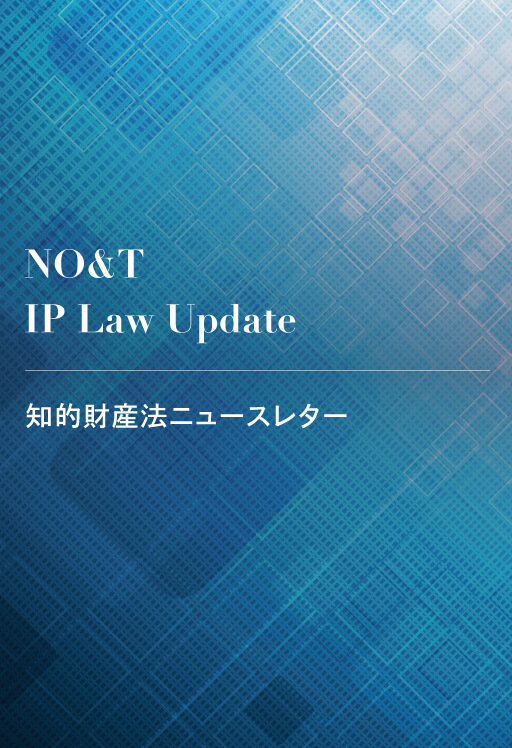
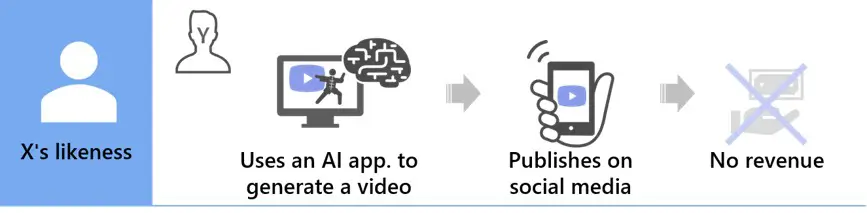
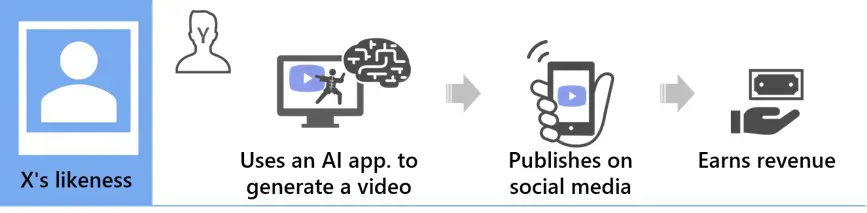
Hypothetical Case 1: Unauthorized use of actor’s likeness in video work
Y, without the authorization of X, an actor, uses a generative AI application to generate a video in which a person whose face closely resembles the face of X performs an action scene, and publishes it on social media, thereby earning revenue.
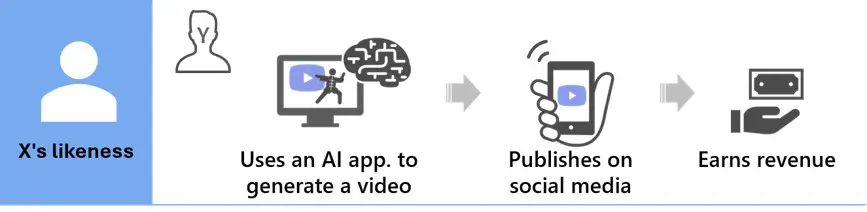
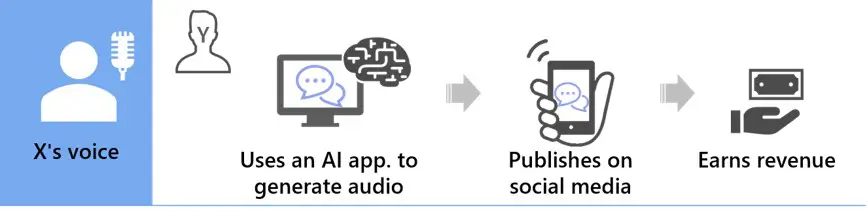
Hypothetical Case 2: Unauthorized use of voice of singer or voice actor (of an animation character played by the voice actor) in distributed audio work
Y, without the authorization of X, uses a generative AI application to generate audio in which a musical composition of A is sung in a singing voice closely resembling the singing voice of X, and publishes it on social media, thereby earning revenue. In Hypothetical Case 2-1, X is a singer. In Hypothetical Case 2-2, X is a voice actor, and the audio in question uses a voice closely resembling that of an animation character, voiced by X.
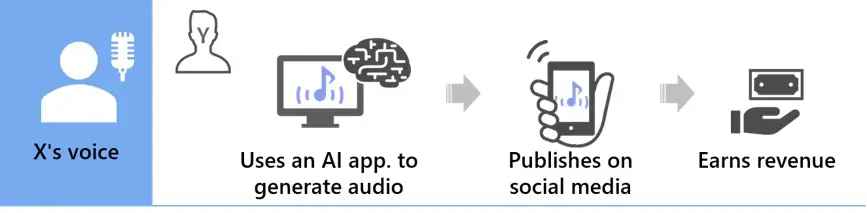
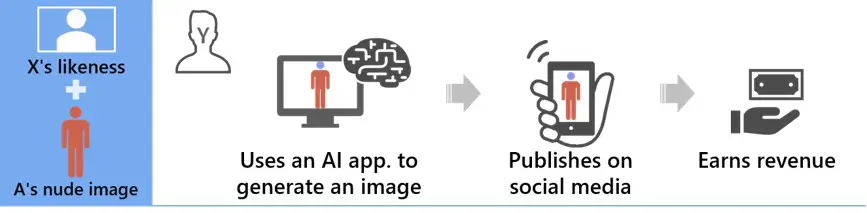
Hypothetical Case 3: Unauthorized use of actor’s likeness or a voice actor’s voice in sexual image or audio work
Hypothetical Case 3-1: Y, without the authorization of X, an actor, inputs the likeness of X and a nude image of A into a generative AI application, instructs it to composite the face of X with the nude body of A, generates an image in which X appears to be naked, and publishes it on social media, thereby earning revenue.
Hypothetical Case 3-2: Y uses a generative AI application to synthesize the voice of X, a voice actor, generates audio in which X appears to be reading out obscene text, and publishes it on social media, thereby earning revenue.
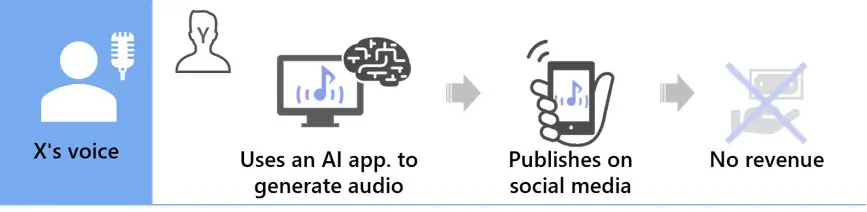
Hypothetical Case 4: Unauthorized use of actor’s likeness or voice actor’s voice without a profit-making purpose
Y, without any profit-making purpose and out of mere curiosity, (i) generates the video in Hypothetical Case 1 and publishes it on social media (Hypothetical Case 4-1), or (ii) generates the audio in Hypothetical Case 2-1 and publishes it on social media (Hypothetical Case 4-2).
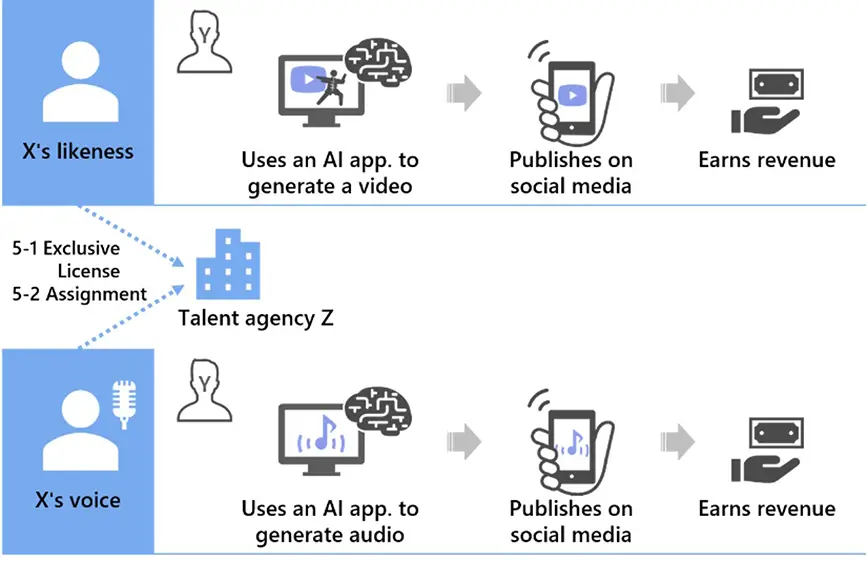
Hypothetical Case 5: Exclusive license or assignment of publicity rights to talent agency to which the person belongs
Under Hypothetical Case 1 or 2-1, X enters into an agreement with talent agency Z that (i) grants Z an exclusive license to use the publicity rights held by X (Hypothetical Case 5-1), or (ii) assigns to Z the publicity rights held by X (Hypothetical Case 5-2).
Hypothetical Case 6: Unauthorized use of likeness of deceased actor in video work
Y uses a generative AI application to create a video work in which a person whose face closely resembles that of X, a deceased actor, performs an action scene, and publishes it on social media, thereby earning revenue.
Hypothetical Case 7: Unauthorized use of likeness of deceased actor in sexual image
Y inputs the likeness of X, a deceased actor, and a nude image of A into a generative AI application, instructs it to composite the face of X with the nude body of A, generates an image in which X appears to be naked, and publishes it on social media, thereby earning revenue.
2. Protection of the right not to have one’s likeness, etc. (including voice) used without due cause
(1) Basis of the analysis
(a) Framework for establishing the infringement
The Report states that, with respect to the criteria for determining whether an infringement of the right not to have one’s likeness used without due cause and the right not to have one’s voice used without due cause (referred to collectively below as the “right not to have one’s likeness, etc. used without due cause”) has occurred, based on the analytical framework set out in the Supreme Court judgment in the Masumi Hayashi v. Shinchosha Publishing Co., Ltd., et al.,※4 and taking into account academic commentary and lower court decisions, one should consider, for each specific case, the interests that constitute the substantive subject matter of protection under the right not to have one’s likeness, etc. used without due cause, and then, in light of the nature of those interests, determine whether an infringement has occurred by thoroughly considering factors such as the social status and activities of the person concerned, and the purpose, manner and necessity of the use of the likeness, etc., from the perspective of whether the infringement exceeds the limits of what is to be tolerated in social life (shakai seikatsu jō no junin gendo).※5
(b) Determining infringement with respect to images or voices output by generative AI
The Report considers that the interpretive guidance described in (a) above also applies to acts of using a likeness, etc., including a voice, output by generative AI.※6 As a premise for determining whether an infringement of the right not to have one’s likeness, etc. used without due cause has occurred, the rights and interests that are substantively deserving of protection in the case at hand should be taken into account: (i) in cases where the subject matter of protection is the right to one’s honor (meiyoken) or privacy, it is necessary that a person who encounters the image or voice in question be able to identify the likeness, etc. used as being that of the person asserting the infringement (the “person concerned”); whereas (ii) in cases where the subject matter of protection is the person’s sense of honor (meiyo kanjō) or the tranquility of private life, it suffices that the person concerned is able to recognize that the image or voice is directed at them.※7
(c) Determining whether infringement is established
For example, with respect to Hypothetical Case 3, the Report states that in relation to the unauthorized use of a likeness, etc. in sexual images or audio, where the conduct causes the person concerned to experience strong feelings of shame or discomfort and injures that person’s self-respect, it is highly likely that the right not to have one’s likeness, etc. used without due cause is infringed, as the conduct unjustly infringes the person’s sense of honor and the tranquility of private life beyond the limits of what is to be tolerated in social life.※8
As examples of factors to be considered in affirming infringement, the Report cites:
-
with respect to (i) sexual images generated by generative AI:
-
the fact that the image gives viewers the impression that it is of the person concerned;
-
the realistic nature of the generated image; and
-
the fact that the generative AI user instructed the use of data of the person’s likeness, etc. and that the use of the person’s likeness can be identified from the image.※9
-
with respect to (ii) sexual audio generated by generative AI, the content of the text being read out.※10
On the other hand, where the person concerned is an actor or voice actor, the scope of their professional activities may in some cases be a relevant consideration, although the Report also states that there was an opinion from a part of the members of the Review Committee that a history of appearing in adult works does not in and of itself serve as a factor negating infringement.※11 Since the right not to have one’s likeness, etc. used without due cause stems from the protection of mental value (i.e., emotional value, in contrast to purely economic or pecuniary value), whether the unauthorized user had a profit-making purpose does not directly affect whether infringement is established; rather, a case-by-case basis determination is made taking into account the purpose of publication and other factors.※12
Finally, as to whether there is a difference in the determination of infringement depending on whether the person concerned is a celebrity or a member of the general public, the Report states that (i) since the right not to have one’s likeness, etc. used without due cause, which stems from the protection of mental value, protects the likeness, etc. of members of the general public as well, and (ii) since it is difficult to identify any difference between celebrities and members of the general public in the degree of shame or discomfort experienced, or the degree to which one’s self-respect is injured as a result of one’s likeness or voice being used in sexual images or audio and published, there is a low likelihood that whether the person concerned is a celebrity or a member of the general public will give rise to a significant difference in whether infringement is established.※13
(2) Rights and interests substantively protected
(a) Analytical framework
In determining whether an infringement of the right not to have one’s likeness, etc. used without due cause has occurred, the nature of the rights and interests substantively protected is to be examined. As examples of rights and interests whose content has been well established and substantively protected, the Report cites privacy, the sense of honor, the tranquility of private life and the like. However, the Report considers that, even in cases where the substantive subject matter of protection cannot readily be characterized as any of these rights or interests, it is possible to conceive of a mental interest in not having one’s likeness placed under the control of another person, and an interest in the integrity of one’s self-image, and to apply the analytical framework described in (1)(a) above to protect the rights of the person concerned.※14
(b) Factors to be considered
For example, in its examination of Hypothetical Case 4, the Report states that for an actor or singer, having their likeness, etc. processed by generative AI without their knowledge, with a high degree of seeming accuracy, and disseminated as if this false information were genuine information about them may injure their mental interest in not having one’s likeness placed under the control of another person, and/or their interests in the integrity of one’s self-image and the like. If the user has a purpose of ridiculing the person concerned, a purpose of acquiring social media followers or view/play counts, or a purpose of using the content for advertising, these are factors which will make it more likely find infringement. On the other hand, generally speaking, where the person concerned is a public official or a candidate in a public election, there may be instances in which they must tolerate the use of their likeness or voice in the context of political criticism or the like, and infringement is to be determined through a comprehensive consideration of these factors.※15
(3) Cases in which a likeness, etc. resembling another person is generated by coincidence
In cases involving the use of generative AI, it is conceivable that an image, audio, or the like bearing a certain degree of resemblance to another person’s likeness, etc. may be generated by coincidence, without the user intending it. In such instances, the Report states that in a case where the user publishes the image, audio or the like without realizing that it resembles another person’s likeness, etc., it is possible that the requisite intent or negligence for liability will not be found and that no liability will be imposed. The Report further states that where the image or the like was generated by coincidence but the degree of resemblance is low, the low degree of resemblance may be a factor weighing against a finding that the limits of what is to be tolerated have been exceeded.※16
On the other hand, where, after the image, audio or the like has been generated by coincidence, the user becomes aware that it resembles another person’s likeness, etc. and, with that awareness, publishes it or continues to publish it, that act of publication (or continued publication) may constitute infringement of the right not to have one’s likeness, etc. used without due cause.※17
It should be noted that even where the information used in the image or audio generation process (training dataset, image prompts, etc.) does not include the person’s likeness, etc., if the generative AI user intended to make the output resemble the person concerned through adjustment of prompts or otherwise, this is not a case of “coincidental generation” and there is a possibility that it constitutes infringement.
(4) Using a likeness, etc. without authorization after the death of the person concerned
The Report states that because the right not to have one’s likeness, etc. used without due cause is a right that protects the mental value of a person’s likeness, etc. that is derived from personality rights, it is extinguished upon the death of the person concerned and is not inherited. However, with respect to using a likeness, etc. without authorization after the death of the person concerned, the Report concludes that the surviving family members may assert infringement of their feelings of “love and reverence for the memory of the deceased” (keiai tsuibo no jō), and may bring claims for damages or injunctive relief.
The analytical framework for this determination is substantially the same as the framework described in (1)(a) above, but in determining whether infringement of feelings of love and reverence for the memory of the deceased is established, additional factors, such as the timing of the use of the likeness, etc. (the period since the person’s death) and the relationship between the deceased and the surviving family members, are to be considered.※18
3. Remedies
For both infringement of publicity rights and infringement of the right not to have one’s likeness, etc. used without due cause, the available remedies are damages and injunctive relief.
(1) Damages
As to the content and scope of damages: (i) damages for infringement of publicity rights are primarily proprietary damages, in particular, lost profits, and in many cases a reasonable royalty amount is recognized as damages by reference to the hypothetical contractual terms (royalty rates, etc.) similar to those ordinarily used by the right holder※19 and court decisions exist which also have recognized damages being available for the impairment of publicity rights itself.※20 On the other hand, no court decisions affirming non-pecuniary damages (damages for emotional distress) were found to exist.※21 In contrast, (ii) damages for infringement of the right not to have one’s likeness, etc. used without due cause are, in principle, recognized as within the scope of damages allowed for emotional distress (Article 710 of the Civil Code),※22 and the amount of damages for emotional distress is calculated through a comprehensive consideration of the relevant circumstances.※23 The damages under (i) and (ii) are separate categories of damage and may co-exist.※24
(2) Injunctive relief
With respect to both publicity rights and the right not to have one’s likeness, etc. used without due cause, claims for injunctive relief are recognized as being permissible under Japanese law and the Report concluded that it is possible, for example, to seek an injunction against the publication of a book in which the images in question are reproduced, or to seek the removal of such images from a website.※25
For the court to issue an injunction, however, the injunction must be necessary to stop the violating or illegal activity – either the elimination of an infringement currently being committed, or the prevention of a future infringement.※26 Assuming such necessity is proven, the Report argues that requests for the deletion of online content may be directed at not only the likeness, etc. creator but also the business operator who manages and operates the platform.※27
4. Practical points
Finally, there are several practical points to note in light of the Report.
(1) Asserting and proving the similarity of a voice
For either publicity rights or the right not to have one’s likeness, etc. used without due cause to be the basis of a claim for damages or injunctive relief, first, the claimant must prove that the likeness, etc. of the person concerned was actually used, and, to prove this requirement the claimant needs to prove the similarity between the likeness, etc. of the person concerned and the likeness, etc. used in the image or audio. In the case of a visual likeness, the person’s likeness and the image in question can be visually compared, and their similarities and differences can be described in writing. Visual likenesses therefore lend themselves relatively readily to assertions of similarity. In the case of a voice, by contrast, even if recordings of the person’s voice and the audio in question are submitted as evidence, it may be difficult to articulate and prove the similarity between them in the same manner. As a method of asserting and proving the similarity between a voice and an audio recording, it may be necessary to obtain scientific analysis, such as the results of voiceprint analysis, to obtain objectively persuasive evidence.※28
On this point, it should be noted that the Report states that, particularly in cases of infringement of publicity rights, the issue is “whether the customer-attracting power possessed by the person’s voice is being exploited to customers,” and that, in determining whether a voice has been used, that is, whether the voice used can be identified as that of the person concerned, scientific analytical methods may constitute one factor to be considered but are not a decisive factor. This observation in the Report may, however, be directed at elements other than the use of a likeness among the requirements for establishing infringement of publicity rights, such as the existence of customer-attracting power of the likeness and the requirement of a purpose that mainly exploiting the customer-attracting power of the likeness. At the same time, it should be noted that, because the use of an audio likeness requires the audio in question to be identifiable as the voice of the person concerned, if, as a factual premise, the objective similarity between the two is not established on the basis of scientific analysis or the like, it is likely that improper use of the likeness will not be found to have occurred on the ground that it is not possible to identify the audio in question as being the voice of the person concerned.
Moreover, for there to be a “use” of the likeness of the person concerned, a person who encounters the likeness must, solely from encountering it, recognize it as the likeness of the person concerned. It would therefore seem that, whether with respect to a visual likeness or an audio likeness, i.e. a voice, for the purposes of asserting and proving that the likeness of the person concerned has been used, it will not be sufficient to merely compare the likeness used with the likeness of the person concerned and to show that they are similar. This is because it is entirely possible for the likeness used, particularly in the case of audio likenesses, to resemble the likeness of more than one person. For example, the likeness used could be similar to the likeness of the person concerned, A, while simultaneously resembling the likeness of other individuals B and C. Accordingly, even if one has asserted and proved that the likeness used is similar to the likeness of the person concerned, that alone does not establish that a person encountering the likeness used would, solely from encountering it, recognize it as the likeness of the person concerned.
Ultimately, the question of what evidentiary methods can be used to authoritatively prove that “a person encountering the likeness, etc. used would, solely from encountering it, recognize it as the likeness, etc. of the person concerned” needs to be carefully considered. The answer is not as obvious as it may first seem. Online reactions to a likeness should also be treated with caution. Reactions on the internet and social media tend to amplify the statements of a few specific individuals, and it is possible to intentionally post online statements from a large number of anonymous sources, making the probative value of online reactions potentially worthless. This would seem to be an issue for future resolution.
(2) Infringement of publicity rights by coincidentally generated similar images or audio
The Report addresses the situation in which images or audio resembling the visual likeness or voice of another person are generated by coincidence only in relation to the right not to have one’s likeness, etc. used without due cause (see Section 2(3) above), and makes no specific reference to the relationship with infringement of publicity rights.
However, for example, where AI-generated audio used by a company in an advertisement happens to resemble the voice of a certain voice actor, a dispute concerning infringement of publicity rights may arise between the voice actor and the company. In such case, with respect to the requirements for establishing infringement of publicity rights, the following points should be noted:
-
The Report states that the existence of customer-attracting power of a voice is determined not objectively based on the celebrity status of the person concerned, but taking into account the specific manner of use (see Section 4.1.1 of Part 1 of this newsletter series); and
-
as mentioned in Section 4(1) above, the existence of the use of a voice is also examined from the perspective of whether the customer-attracting power possessed by the person’s voice is being exploited to customers, and is to be determined through consideration of the degree of resemblance together with any additional relevant information. (see also Section 4.1.2 of Part 1 of this newsletter series).
In other words, whether the voice possessed customer-attracting power to the relevant customers, and whether there was a use of the voice that enabled customers to identify it as the voice of the person concerned, are likely to be determined through specific assertions and proof regarding the particular manner in which the voice was used and the existence of any additional information evoking the person concerned.
In cases of coincidental resemblance, there are likely to be relatively few circumstances at the outset that would support a finding of infringement, such as a particular manner of use giving rise to customer-attracting power in the voice or additional information enabling the voice to be identified as that of the person concerned. However, if after publication, the publisher/user of the audio in question becomes aware of the resemblance between the audio in question and the voice of the person concerned and, upon realizing this, adds elements evoking the person concerned and continues to publish it, the customer-attracting power of the voice and the use of the voice is likely to be affirmed on the basis of the subsequent manner of use and additional information (i.e., the situation will shift in the direction of affirming infringement).
In any event, as noted in Section 4(1) above, given the inherent difficulty in establishing that “a person encountering the likeness, etc. used would, solely from encountering it, recognize it as the likeness, etc. of the person concerned,” the presence or absence of the “additional information” is likely to be an important factor determining the outcome.
5. Conclusion
Although the Report is not legally binding, it organizes and summarizes existing legal discourse on publicity rights and the right not to have one’s likeness, etc. used without due cause related judicial precedents, court decisions, and academic commentary. Given the current lack of extensive precedent concerning the use of generative AI, the Report is therefore likely to be of practical reference value to both rights holders and users of likenesses generated by AI.
At the same time, the Report is not a complete answer. The hypothetical cases in the Report represent only a subset of the various possible types of AI-generated visual and audio use. Issues involving how to prove infringement, such as the issues identified in Section 4 above also remain unresolved. While the Report is a much needed and highly useful guide, it remains necessary to continue to monitoring judicial activity in the courts and the approaches taken in legal practice towards the creation and use of generative AI sourced human likenesses.
Endnotes
*1
A publicity right is the right to exclusively exploit the customer-attracting power of a person’s name, or likeness, etc. It stems from the commercial value of a person’s likeness, etc. itself, and constitutes one of the rights derived from personality rights.
*5
Hypothetical Case 3, Hypothetical Case 4.
*7
Hypothetical Case 3-1, Hypothetical Case 3-2. In either case, where the output likeness, etc. does not resemble that of the person concerned and, even taking other materials into account, cannot be said to be directed at the person concerned, it is not appropriate to find infringement of the right not to have one’s likeness, etc. used without due cause.
*8
Hypothetical Case 3-1, Hypothetical Case 3-2.
*9
Hypothetical Case 3-1.
*10
Hypothetical Case 3-2.
*11
Hypothetical Case 3-1, Hypothetical Case 3-2.
*12
Hypothetical Case 3-1, Hypothetical Case 3-2. See also Hypothetical Case 4 to the same effect.
*13
Hypothetical Case 3-1, Hypothetical Case 3-2.
*16
Hypothetical Case 3-1, Hypothetical Case 3-2.
*17
Hypothetical Case 3-1, Hypothetical Case 3-2.
*18
In relation to Hypothetical Case 7, the Report states that as a general matter, the fact that a short period has elapsed since the person’s death, and the fact that the surviving family members are close relatives of the deceased are factors weighing in favor of affirming that the limits of what is to be tolerated have been exceeded.
*19
Hypothetical Case 1. With respect to the calculation of lost profits, the issue of application for damages for lost profits by analogy to Article 114 of the Copyright Act arises, however, in practice, damages for lost profits are in many cases calculated on the basis of a reasonable royalty amount, whether or not application by analogy to paragraph 3 of Article 114 of the Copyright Act is expressly stated in the decision.
*20
With respect to a magazine article in which comments intended to arouse the sexual interest of readers were appended to photographs, the judgment of the Tokyo District Court of April 26, 2013 (Heisei 25), Hanrei Times No. 1416, p. 276, recognized such damages; see Hypothetical Case 3-1.
*22
Hypothetical Case 3-1.
*23
In Hypothetical Cases 3-1 and 3-2, factors to be considered include the fact that sophisticated images, etc. have been generated by generative AI, and the extent of dissemination of the images, etc. on social media.
*24
Hypothetical Case 3-1.
*25
Hypothetical Case 1, Hypothetical Case 3-1.
*26
Hypothetical Case 1, Hypothetical Case 3-1.
*27
Hypothetical Case 1, Hypothetical Case 3-1.
*28
In November 2025, the voice actor and actor Kenjiro Tsuda attracted attention by filing a lawsuit against the operator of TikTok, seeking the deletion of videos that imitated his voice using generative AI based on the Unfair Competition Prevention Act and publicity rights. It is reported that in that lawsuit, evidence was submitted consisting of comparative analysis and analysis results from an acoustic analysis AI model of the audio in question and the plaintiff’s voice. (Toshiya Kaneko, “Use of Likenesses and Voices (or Things Resembling Them) in the Age of AI, and the Rights of Performers,” Jurist No. 1625 (July 2026), pp. 36–37).